Newsletter: Edition 12

Greetings TB Think Tank members! This quarter reveals the powerful synergy between our present actions and our future ambitions in the fight against TB. While our groundbreaking End TB Campaign demonstrates what is achievable today, we are simultaneously laying the foundation for the transformative tools of tomorrow. 

For full article, click here

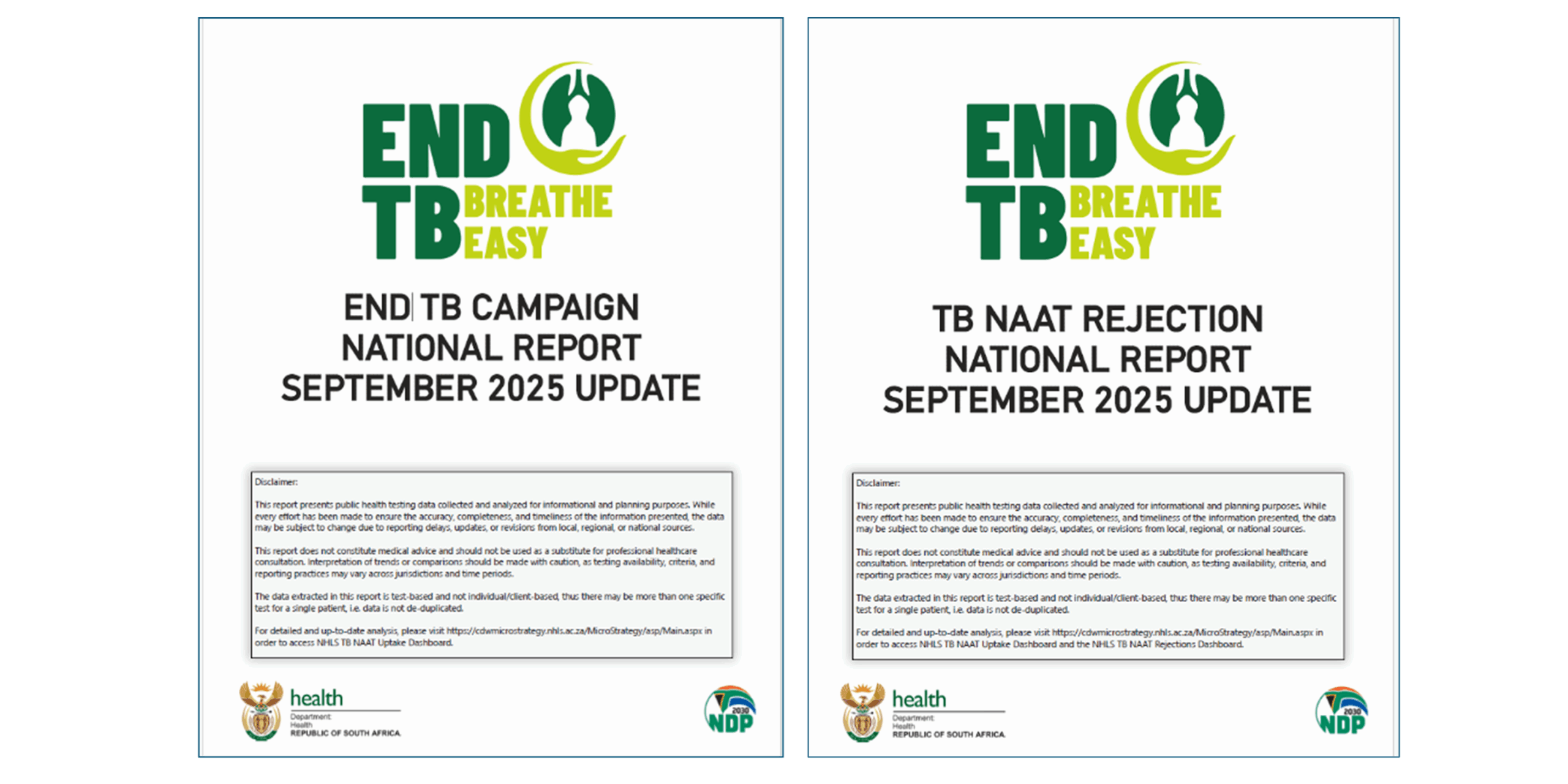
Our front cover rightly celebrates the accelerating momentum of the End TB Campaign. This nationwide push to test, treat, and prevent is the bedrock of our response today. The impressive milestones, from the real-time data dashboard to the declining sputum rejection rates, demonstrate what is possible when we coordinate, communicate, and hold ourselves accountable. This campaign is our engine for finding the missing people with TB now and preventing further transmission. 

Crucially, this solid foundation paves the way for tomorrow’s breakthroughs. In late July, we took a monumental step forward by convening the first-ever TB Vaccine Preparedness Workshop. As detailed in this newsletter, the workshop united the nation’s key decision-makers to begin crafting a concrete roadmap for the day we have a new vaccine in hand. The dialogue has started, and the TB Think Tank is committed to ensuring this momentum translates into actionable plans for system readiness, evidence generation, and community trust. 

Further energising this momentum are the three innovative projects selected from our recent Call for Concepts. From a web-based clinical tool to WhatsApp microlearning and a national sputum collection video, these member-driven initiatives exemplify the practical, scalable solutions that the Think Tank exists to foster. They remind us that innovation is not always a giant leap, but often a smarter, more effective step in our daily work. 

This spirit of collaboration and learning was also vividly displayed at the SA AIDS Conference 2025, where our members contributed meaningfully to critical discussions on funding, integration, and innovation. 

In this edition, you will see how each thread of all the TB work in South Africa, from campaign implementation and research to policy shaping and future preparedness, is weaving together to form a stronger, more resilient TB response for all South Africans. 

Thank you for your continued dedication. 

Warm regards, 

Priashni Subrayen 
Lead, TB Think Tank Secretariat 

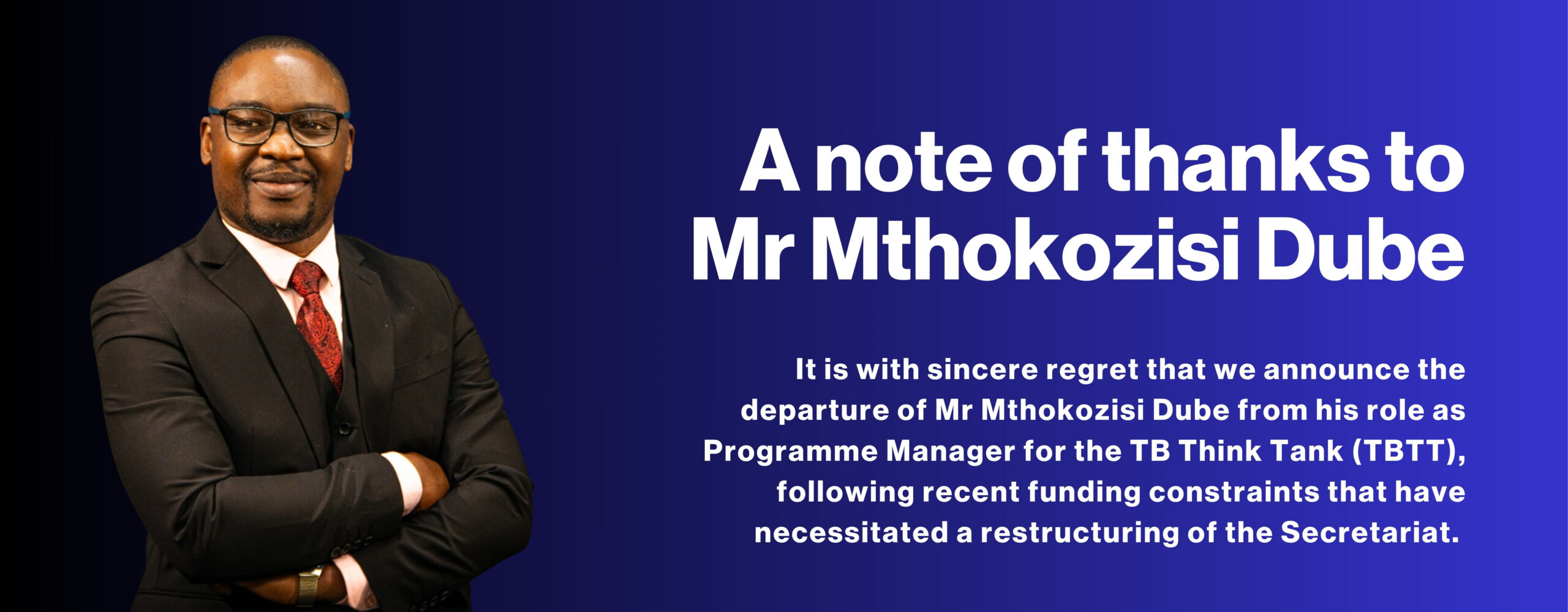
It is with sincere regret that we announce the departure of Mr Mthokozisi Dube from his role as Programme Manager for the TB Think Tank (TBTT), following recent funding constraints that have necessitated a restructuring of the Secretariat. 

Mr Dube joined the TB Think Tank Secretariat in June 2022, bringing with him significant experience in project leadership within South Africa’s TB response. He holds a BSc (Honours) in Nursing and a Master’s in Public Health from the University of Pretoria, and he will soon embark on a PhD.

For full article, click here

During his tenure, Mthoko played a central role in strengthening coordination across the TBTT’s diverse workstreams and managing a complex portfolio of donor-funded projects. His quiet yet effective leadership style fostered collaboration and trust among partners, including the National Department of Health and Task Team leadership. 

Those who have worked closely with Mthoko will know him as a calm, driven, and deeply committed leader who believed strongly in the power of the TB Think Tank to influence policy and improve TB outcomes. He worked tirelessly to strengthen relationships and ensure that the TBTT’s collective efforts were translated into meaningful action. His sincerity, hard work, and steady presence have left a lasting mark on the Secretariat and the wider TB community. 

Reflecting on his time with the Secretariat, Mthoko shared, “I am deeply grateful for the privilege to have served the Think Tank and am hopeful for what lies ahead.” 

While Mthoko will continue to contribute to TB work within the Aurum Institute, we take this opportunity to express our deep appreciation for his dedication, competence, and collegiality. 

In the interim, Ms Farzana Sathar and Ms Nolwazi Nkosi will jointly support the coordination of TBTT activities while a broader programme restructure is being organised. 

On behalf of the TB Think Tank Secretariat and partners, we thank Mthoko warmly for his service and wish him every success in his next chapter. 

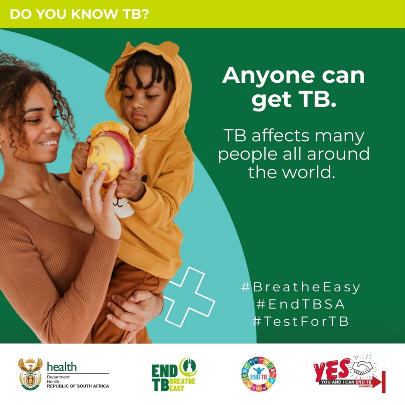
On World TB Day 24 March 2025, the National Department of Health (NDoH) officially launched the End TB Campaign – a nationwide initiative to close gaps in TB detection, treatment and prevention. The goal of the campaign is clear: test at least 5 million people for TB every year, link people to care earlier, and prevent TB transmission in communities. Modelling shows that if South Africa reaches and sustains this testing target, TB incidence and mortality will decline significantly over the next ten years. The campaign is therefore central to rebuilding TB services after COVID-19 and meeting the National Strategic Plan targets. The launch, led by the Deputy President and Minister of Health, united provinces, civil society, research partners and implementing organisations behind one message: Test, Treat, Prevent TB – Now! 

For full article, click here

Since the launch, significant progress has been made in planning, communication, implementation, data transparency, and monitoring. Below is a summary of milestones achieved, through strong collaboration between the National TB Programme, NICD, NHLS, SANAC, and provincial TB teams.

Strategic Planning and Coordination 

A national End TB Campaign Plan with annual testing targets was developed and cascaded to province, district and facility level. This has strengthened accountability across all levels of the health system. The SANAC TB Technical Task Team has established the End TB Campaign technical working group.

A governance framework is now in place at NDoH, and provincial TB champions have been appointed. To date, seven provinces have finalised implementation plans, with the remaining two in progress. Plans prioritise optimising Test, Treat, Prevent (TUTP) strategies and targeted case finding.

Social and Behaviour Change Communication (SBCC) 

To build public demand and community mobilisation, the campaign launched a national End TB digital awareness drive under #EndTBSA. Co-creation workshops were held with civil society, youth leaders, provincial teams and partners to localise messaging and ensure relevance at community level. 

A comprehensive SBCC toolkit- including posters, banners, scripts, educational messages and community activation guides – has been rolled out. SBCC training sessions are being conducted in provinces to support consistent campaign messaging and outreach. 

Data Transparency and Innovation 

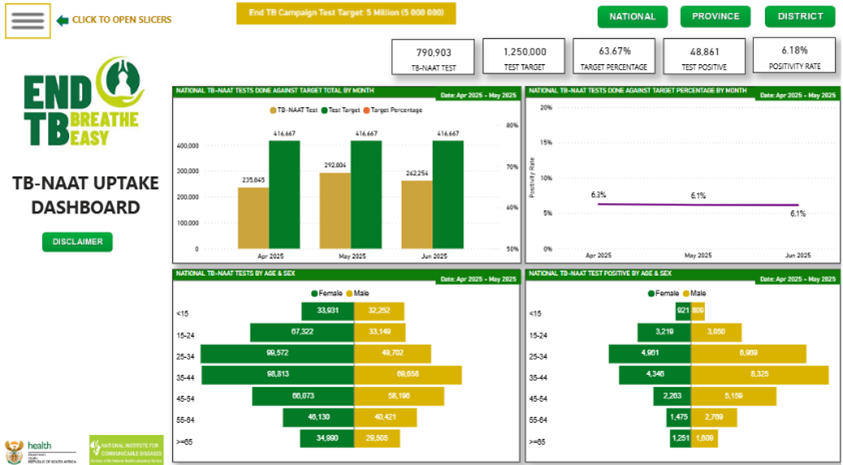
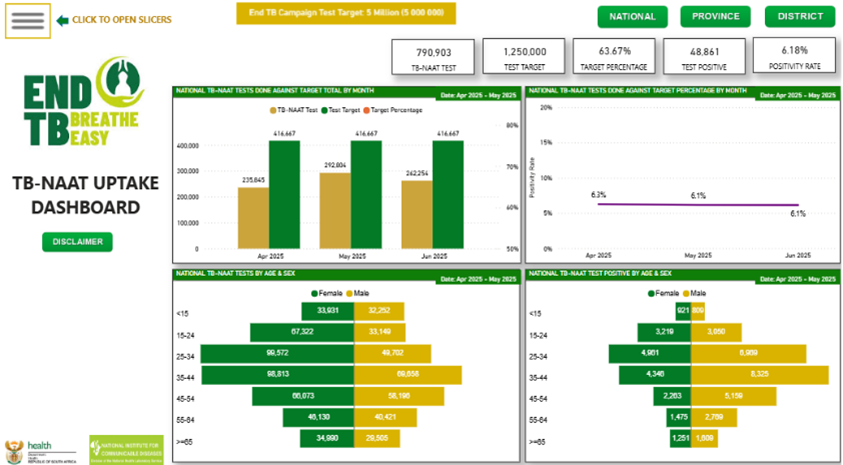
A major campaign milestone is the new End TB Campaign Dashboard, developed by the NDoH in partnership with NICD and NHLS, with input from civil society. This public-facing dashboard provides real-time TB NAAT testing trends by province, district, facility, age and sex, and tracks performance against End TB targets. The dashboard will be formally launched on 24 October with the Minister of Health. 

To improve operational quality, a second tool – the Sputum Rejection Dashboard—was introduced to help provinces monitor rejection trends and address avoidable testing losses.

Strategic Planning and Coordination 

A national End TB Campaign Plan with annual testing targets was developed and cascaded to province, district and facility level. This has strengthened accountability across all levels of the health system. The SANAC TB Technical Task Team has established the End TB Campaign technical working group. 

A governance framework is now in place at NDoH, and provincial TB champions have been appointed. To date, seven provinces have finalised implementation plans, with the remaining two in progress. Plans prioritise optimising Test, Treat, Prevent (TUTP) strategies and targeted case finding. 

Campaign Implementation 

Implementation momentum is increasing rapidly. All provinces have launched testing scale-up initiatives and sputum quality improvement (QI) campaigns. Importantly, most provinces have now embedded End TB monitoring into their provincial ‘nerve centre’ or performance review platforms, making it part of routine service delivery governance. 

District-led testing outreaches, workplace campaigns, and school TB screening drives have been implemented to increase access in high-burden communities. 

Monitoring, Accountability and Recognition

Monthly End TB performance reports are now circulated to provinces, tracking trends in TB testing and sputum rejection. Monthly provincial End TB “huddles” are held with the National TB Programme to review performance, share best practices and unblock implementation barriers. From November, NDoH will launch End TB Recognition Awards to celebrate top-performing facilities, districts and provinces that meet or exceed campaign targets.

Integration with the Close the Gap HIV Campaign 

The End TB Campaign has worked closely with the Close the Gap HIV Campaign, which aims to return 1.1 million people to ART treatment. End TB updates are now presented at the routine Close the Gap M&E meetings, enabling joint performance reviews, harmonised communication, and coordinated action across programmes. This collaboration exemplifies the Department’s integrated approach to tackling TB and HIV as linked epidemics—improving efficiency, reach, and overall impact.

Early Signs of Impact 

Between January and September 2025, South Africa recorded 119,756 TB NAAT sample rejections. The national rejection rate improved from 6.3% in January to 3.6% in September. 

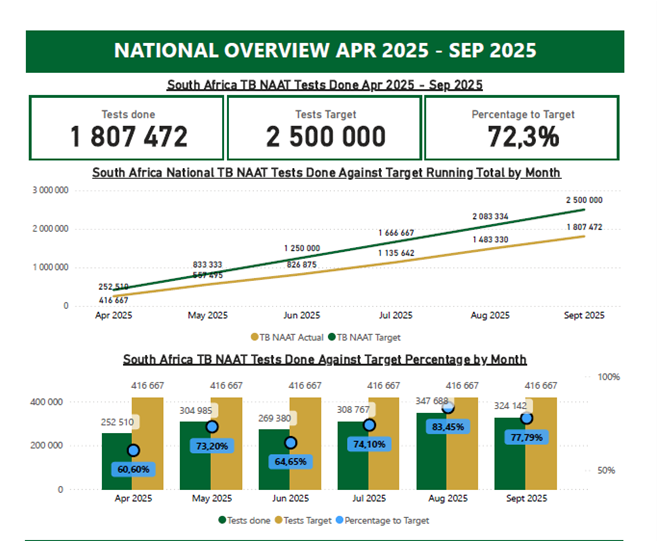
In the first six months of implementing the End TB Campaign, between April and September 2025, the country completed 1,807,472 TB NAAT tests, achieving 72.3% of the 2.5 million mid-year target. KwaZulu-Natal led in total tests (499,541). Cape Winelands District achieved the highest percentage performance (87.3%). 

South Africa is building real momentum in the fight against TB. Through stronger coordination, better data, and visible delivery, the End TB Campaign is turning commitment into action – and action into impact.
– Dr Waasila Jassat, TB Technical Support Unit (TSU), TB Control and Management Cluster, NDoH

Early Signs of Impact 

Between January and September 2025, South Africa recorded 119,756 TB NAAT sample rejections. The national rejection rate improved from 6.3% in January to 3.6% in September. 

In the first six months of implementing the End TB Campaign, between April and September 2025, the country completed 1,807,472 TB NAAT tests, achieving 72.3% of the 2.5 million mid-year target. KwaZulu-Natal led in total tests (499,541). Cape Winelands District achieved the highest percentage performance (87.3%). 

South Africa is building real momentum in the fight against TB. Through stronger coordination, better data, and visible delivery, the End TB Campaign is turning commitment into action – and action into impact.
– Dr Waasila Jassat, TB Technical Support Unit (TSU), TB Control and Management Cluster, NDoH

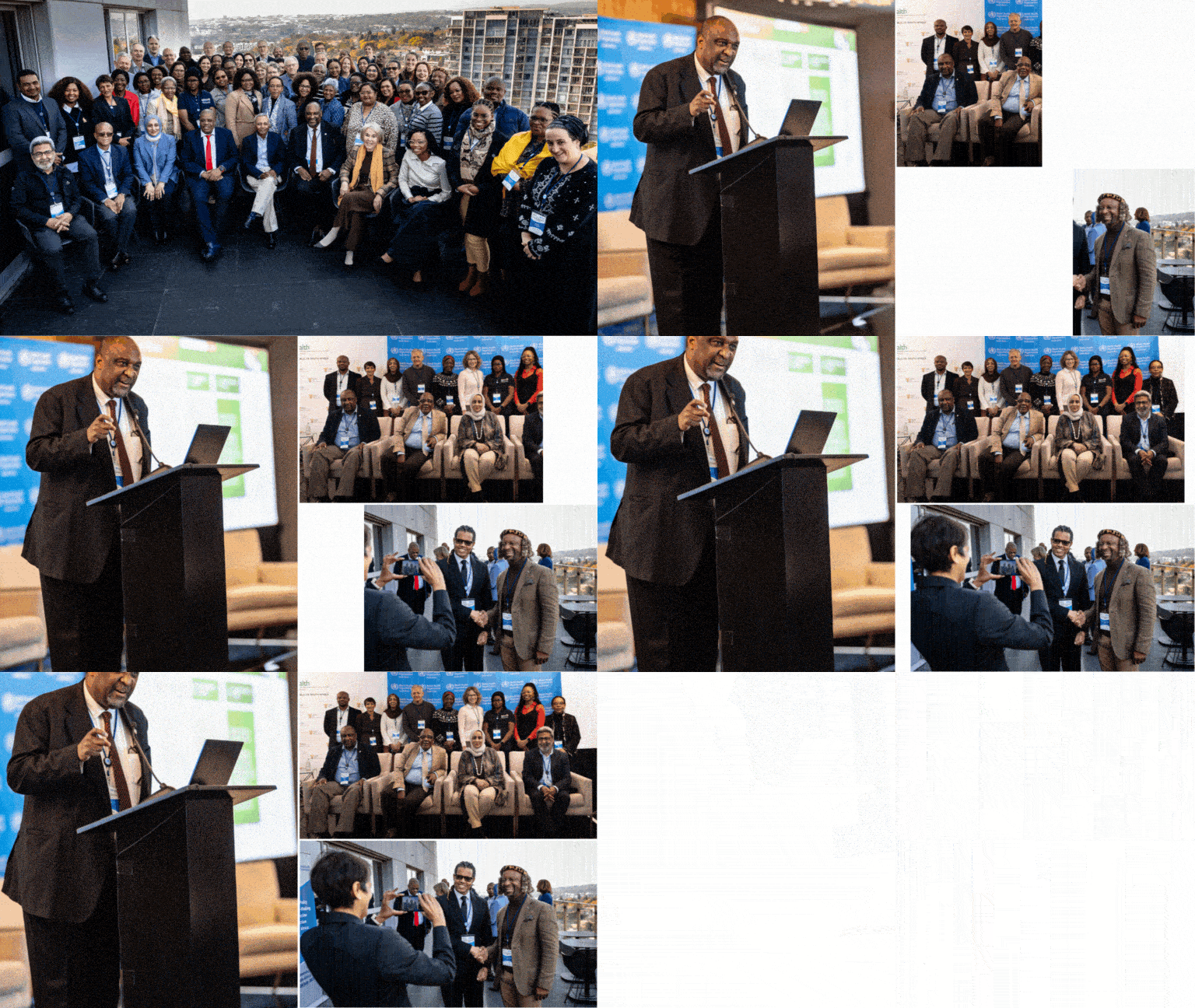
I am thrilled to report on a landmark event: the first-ever South Africa TB Vaccine Preparedness Workshop, held in July 2025. Convened by the National Department of Health and the World Health Organization, this gathering united over 85 leaders from government, research, manufacturing, civil society, and global health.

For full article, click here

The message was clear and unanimous: after decades of waiting, new TB vaccines for adolescents and adults are on the horizon, with the M72/AS01E candidate leading the way and expected to complete its Phase III trial by 2028. This is a game-changer. Modelling shows that a vaccine with 50% efficacy could prevent 1.6 million TB cases and 220,000 deaths in South Africa by 2050. Crucially, even a vaccine with lower efficacy could be highly cost-effective.

However, the workshop underscored that scientific success does not automatically equal public health impact. Our discussions identified critical priorities for action:

  • System Readiness: Our adult vaccination platforms need strengthening. We must address staffing shortages in the immunization program and plan for integrating TB vaccination into existing services like HIV clinics and schools.
  • Evidence Generation: We need South Africa-specific data on cost-effectiveness and must plan for post-licensure studies in key groups like pregnant women and people with uncontrolled HIV.
  • Financing the Future: As an upper-middle-income country ineligible for Gavi support, we must develop innovative domestic financing strategies to ensure sustainable access.
  • Community Trust: Building vaccine confidence is non-negotiable. We will leverage the National TB Campaign and work with community leaders to counter stigma and misinformation.

This workshop was not just about discussion; it was the first step in building a concrete roadmap for accelerated introduction. The Think Tank is committed to driving this agenda forward, ensuring that when a vaccine is available, South Africa is ready to deliver it swiftly and equitably. The fight to end TB is entering a new, hopeful phase.

Together, we can turn the promise of a TB vaccine into a life-saving reality.

Dr. Lee-Ann Davids, Technical Lead: Monitoring, Evaluation and Research Office of AIDS and TB Research (SAMRC)

SA AIDS 2025 was a critical opportunity for practitioners, advocates, researchers, policy makers and all others in the HIV community to reflect on the devastating harms caused by the USA funding cuts, lend support to one another and to strategise a way forward. Notably this conference moved from its home in KwaZulu Natal to a different venue in Gauteng. Despite this, the vibrant culture of community participation and robust discussion was maintained. It was appropriate that funding challenges, injectable HIV prevention – notably Lenacapavir, an ageing HIV population, differentiated models of care and services for key and vulnerable populations dominated throughout the conference.

For full article, click here

The South African TB Think Tank was well represented at the conference and made important contributions. This included a presentation on the impact of USA funding cuts on TB services and research in South Africa, an evaluation of the influence of the SA TB Think Tank on South African policy and describing approaches to HIV positive persons who are hospitalised with possible TB to decrease the risk of early in-hospital mortality. Several other members of the Think Tank were in attendance and made valuable contributions in the form of posters.  

There were numerous discussions around funding for health. Fareed Abdullah, co-chair of the SA TB Think Tank, together with his team hosted a satellite session on innovative financing instruments to improve health outcomes. This session received very positive inputs from, amongst others, Dr. Anban Pillay who is the Deputy Director General at the National Department of Health and Mitchell Warren who is the Executive Director of AVAC and who has spent decades devoted to expanding access to HIV prevention. Pillay and Warren lauded the work done by Abdullah and his colleagues in the field of innovative financing for health and showed enthusiasm for how similar financing instruments can be used to improve outcomes of both HIV and TB.  

The organisers of SA AIDS 2025 were able to produce a successful conference albeit during a tremendously challenging time. It was clear that we cannot go about business as usual.   Dr. Anna Grimsund, Senior Technical Advisor for the International AIDS Society summarized the way forward aptly: We need to rethink financing, rebuild our momentum and rise to defend evidence-based responses. 

Mrs Jacqui Ngozo –  Chief director: Strategic Health Programme in KZN

The 12th South African AIDS Conference (SAAIDS 2025) took place in Johannesburg, South Africa, from September 8–11, 2025, at Emperors Palace. This marked the first time the event was held outside Durban, where it is traditionally hosted at the Inkosi Albert Luthuli International Convention Centre Complex. The conference convened leaders, researchers, academics, and advocates from across South Africa and the globe to discuss the latest developments in HIV care and prevention under the theme “Unite for Change – Empower Communities and Redefine Priorities for HIV/AIDS.” 

One of the key sessions, Leveraging Innovation and Friendships to Improve HIV Testing, Treatment, and Care, focused on integrating advanced digital health technologies and new biomedical prevention tools into routine Department of Health services. Participants discussed how peer influence and social networks could be used to enhance HIV testing uptake, particularly among men and other groups less likely to test. An omnichannel, AI-enabled recruitment platform was proposed to support outreach and engagement, complemented by the inclusion of HIV self-testing as a confidential and convenient option designed through collaboration with the Department of Health and community stakeholders. 

A recurring theme throughout the conference was community empowerment—promoting a shift from top-down, clinic-based approaches toward community-owned and driven HIV/AIDS programs. Empowering communities to design and manage interventions was emphasized as key to addressing structural barriers and improving outcomes. The need for a coordinated response was also underscored, calling for integration across HIV, Tuberculosis, and Sexually Transmitted Infections through stronger partnerships and greater community involvement. 

Among the new prevention strategies discussed was the introduction of Lenacapavir, a long-acting injectable for HIV prevention. With promising results from South African trials, the country is poised to be among the early adopters of this intervention, which could be rolled out in 2026 pending approval. 

Funding sustainability emerged as a pressing concern. Participants discussed the challenges posed by decreasing financial support and the need for stronger collaboration to maintain progress. There was broad consensus that HIV responses must move away from generalized interventions toward more focused, data-driven strategies based on localized incidence and prevalence trends. 

The discussions also highlighted the importance of integrating sexual and reproductive health and rights (SRHR) into HIV programming, linking these to broader goals of gender equality and equitable access to care. Participants stressed the need for continued advocacy, policy integration, and awareness-raising to ensure that SRHR remains central to the HIV response. 

Concerns were raised about the risk of disengagement from care, particularly among individuals living with HIV who stop treatment. This disengagement contributes to advanced HIV disease and increased mortality, underscoring the need for improved retention strategies. 

Finally, the conference reaffirmed commitment to achieving the 95-95-95 goals by 2030 as a critical milestone in ending HIV as a public health threat. Attendees emphasized the importance of strengthening community-led responses, utilizing data to refine strategies, and expanding access to innovative prevention options. The overarching takeaway was clear: achieving the 2030 goals will require collective action, smarter use of data, and sustained investment in both scientific innovation and community empowerment. 

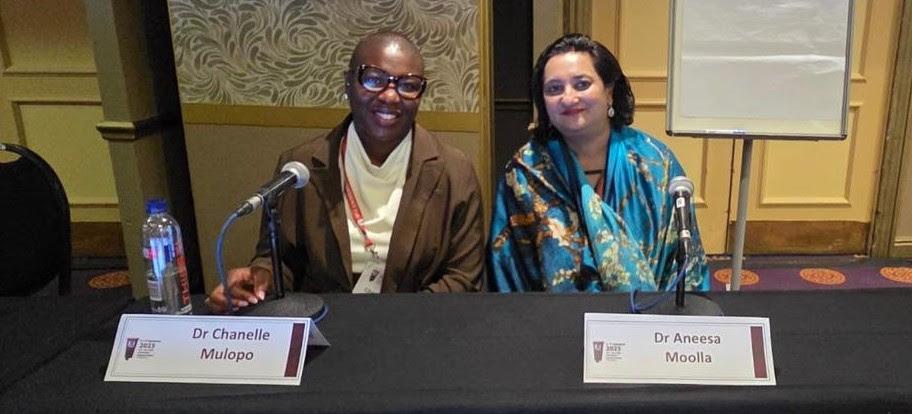
Dr Chanelle Mulopo – Public Health Social Scientist 

I had a great time attending the 12th SA AIDS Conference, which brought together approximately 1,000 delegates – including policymakers, researchers, civil society leaders, and global health partners – to recalibrate South Africa’s HIV response amid shifting global health dynamics. 

One of the key sessions I attended was the Pre-Conference Session on Integrating Self-Care and Clinical Care: The Role of AI in Leveraging Client Journeys and Augmenting Care Pathways. This session explored how artificial intelligence (AI) can bridge self-care and clinical care to enhance client experiences and strengthen health systems. My key takeaway was that while much focus is placed on ensuring AI solutions meet client needs, sustainable integration also requires addressing the realities faced by healthcare providers. For AI to be truly beneficial and sustainable within health systems, it must simplify workflows, reduce administrative burdens, and add clear value for providers who are already overextended and managing multiple priorities. Any additional responsibilities introduced through AI must demonstrate tangible benefits aligned with what healthcare workers value most – improved efficiency, reduced stress, and better patient outcomes. 

The Scientific Breakout Session on Introduction to Behavioural Economics and Applying Key BE Principles to HIV Programmes: A Hands-On Workshop was another highly engaging and interactive session. It provided an overview of behavioural economics concepts and practical skills for integrating them into HIV prevention and care programmes. Through this session, I gained a deeper understanding of how behavioural insights can be strategically applied to influence decision-making, improve uptake of HIV services, and enhance adherence. The session emphasised low-cost, evidence-based interventions that address real-world behavioural barriers, complemented by practical field examples. 

I also found the session on Transforming Men’s Health: From Hard-to-Reach to Engaged particularly informative. Researchers explored innovative approaches to increasing men’s engagement in HIV prevention and care services – a critical area in the fight against HIV. The discussions highlighted the importance of gender-responsive strategies that reframe men not as “hard-to-reach,” but as individuals requiring tailored, contextually relevant engagement. I learned how community-based models, peer support, and integrated service delivery can strengthen participation and improve health outcomes among men. 

Overall, the conference was highly informative and provided valuable opportunities for learning and exchange. I also gained new insights during the session in which I presented on evaluating the influence of the TB Think Tank on South African Policy. 

I would like to express my sincere gratitude to Dr. Bey-Marrie Schmidt, who led the evaluation, and to Ms. Lilian Mayieka, with whom we worked on the project, as well as to the Aurum Institute for funding my conference attendance.  

On 4 June 2025, the TB Think Tank launched a Call for Concepts to all its members, inviting innovative project ideas aimed at strengthening South Africa’s TB response. Members were given 6 weeks to submit their concepts and the response was impressive. A total of 14 concepts were received, covering a wide range of focus areas across the TB care continuum. Each concept underwent a rigorous adjudication process by the TB Think Tank Secretariat and an external reviewer. From this initial review, 7 top-scoring concepts were shortlisted and invited to present their ideas to the Chair of the TB Think Tank, Prof. Norbert Ndjeka, and the Funder representative, Gaurang Tanna. The panel evaluated the presentations and selected the top three to receive funding support. 

We are pleased to announce the 3 selected projects that stood out for their innovation and impact: 

Data Systems and Innovation Task Team 

Project: Web-based TB Clinical Decision Application 

Focus: Developing a digital platform to support clinical decision-making in TB management. 

TB Prevention Task Team 

Project: WhatsApp-based Microlearning for Healthcare Practitioners on Novel TPT Guidelines 

Focus: Using mobile technology to strengthen healthcare worker knowledge and uptake of new tuberculosis preventive treatment (TPT) guidelines. 

Finding the Missing People with TB Task Team 

Project: Strengthening TB Diagnosis through Better Sputum Collection – A National Training Video on the Extended Spot Method 

Focus: Improving the quality of TB diagnosis through enhanced sputum collection training and standardization. 

The selected projects represent practical, scalable ideas that will help advance TB prevention, diagnosis, and care in South Africa. Stay tuned for updates on the progress and outcomes of these exciting initiatives in upcoming editions of the TB Think Tank Newsletter. 

Catch up on the Think Tank’s recent webinar series, now available to watch online!  

First up, “Every Breath You Take: Investigating the Role of Aerosol Sampling in TB Infectiousness, Transmission, and Diagnosis” with Dr Rouxjeane Venter. 

Next, the Think Tank hosted a Feedback Discussion on the TB Vaccine Preparedness Workshop, featuring expert insights from Dr Nkateko Mkhondo, Dr Lee Fairlie and Prof Willem Hanekom. The session was facilitated by our very own Dr Priashni Subrayen, making for a lively and informative conversation. 

“Practical Tools to Strengthen Diagnosis, Treatment, and Prevention of TB in Children” brought together Dr Juli Switala, Dr Sipho Nyathie and Dr Sandy Picken to share actionable strategies and innovations to improve outcomes for our youngest patients.  

Lastly, the long-anticipated South Africa Standard Operating Procedure (SOP) for digital chest X-ray (dCXR) in community screening programmes was introduced. The session presented Orientation to the South Africa Standard Operating Procedure for Digital Chest X-ray in Community Screening Programmes and provided an opportunity to address questions on practical use. 

Every Breath You Take Investigating the role of aerosol sampling in TB infectiousness, transmission.

Special Edition Webinar on the Feedback Discussion on the TB Vaccine Preparedness Workshop

Practical tools to strengthen diagnosis, treatment and prevention of TB in children.

Orientation to the South Africa Standard Operating Procedure for Digital Chest X ray

Banholzer, N., Muula, G., Mureithi, F., Evans, D., Huwa, J., Rafael, I., Kunzekwenyika, C., Jinga, N., Fernando, A., Thawani, A., Schmutz, R., Bolton, C., Günther, G., Egger, M., Haas, A. D., Sweetland, A. C., Ballif, M., Fenner, L., & IeDEA Southern Africa (IeDEA-SA). (2025). Mental, physical, and respiratory health in people with tuberculosis in Southern Africa: A multi-country cohort analysis. BMC Medicine, 23, Article 4321. https://doi.org/10.1186/s12916-025-04321-6

Bergman, A. J., Kadernani, Y. E., Mlandu, K., Lowensen, K., Ndjeka, N. N., Evans, D., & Farley, J. E. (2025). Substance use during rifampicin-resistant TB treatment. The International Journal of Tuberculosis and Lung Disease, 29(8), 378–380. https://doi.org/10.5588/ijtld.24.0591

Bezuidenhout, C., Long, L., Nichols, B., Meyer-Rath, G., Fox, M. P., Olifant, S., Theron, G., Fiphaza, K., Ruhwald, M., Penn-Nicholson, A., Fourie, B., & Medina-Marino, A. (2024). Using sputum and tongue swab specimens for in-home point-of-care targeted universal testing for TB of household contacts: An acceptability and feasibility analysis. medRxiv. https://doi.org/10.1101/2024.11.01.24316570

Bezuidenhout, C., Long, L., Nichols, B., Meyer-Rath, G., Fox, M. P., Theron, G., Fourie, B., Olifant, S., Penn-Nicholson, A., Ruhwald, M., & Medina-Marino, A. (2024). Sputum and tongue swab molecular testing for the in-home diagnosis of tuberculosis in unselected household contacts: A cost and cost-effectiveness analysis. medRxiv. https://doi.org/10.1101/2024.10.18.24315746

Courtney, I. J., Palmer, M., Swanepoel, R., Lombard, C. J., van Niekerk, M., Dunbar, R., McCollum, E. D., Schaaf, H. S., Gie, A., Goussard, P., Hesseling, A. C., Jongen, V. W., & van der Zalm, M. M. (2025). Lung function trajectories in children with pulmonary TB and non-TB lower respiratory tract infections. International Journal of Tuberculosis and Lung Disease Open, 5(1). https://doi.org/10.5588/ijtldopen.25.0080

Firfirey-Brijlal, N., & Janse van Rensburg, A. (2025). Advocating for a socially accountable package of care for adults hospitalized with tuberculosis in the Western Cape, South Africa: A policy brief. Social Innovations Journal, 32. Retrieved from https://socialinnovationsjournal.com/index.php/sij/article/view/10756

Jinga, N., Hirasen, K., Ivanova, O. et al. One year on – the long-term impact of COVID-19 pandemic and government restrictions on the health-seeking behaviour, financial security and mental health of TB survivors. BMC Public Health 25, 2660 (2025). https://doi.org/10.1186/s12889-025-24006-2

Jassat, W., Moshabela, M., Nicol, M. P., Dickson, L., Cox, H., Mlisana, K., Black, J., Loveday, M., Grant, A. D., Kielmann, K., & Schneider, H. (2025). Decentralising DR-TB care: The trade-off between quality of care and service coverage in the early phase of implementation. Public Health Action, 15(1). https://doi.org/10.5588/pha.25.0004

Johnson, L. S., Anthony, M. G., Purdy, C., Luke, V., van Deventer, H., van Niekerk, M., Viljoen, L., & van der Zalm, M. M. (2025). Caregiver perspectives on TB-related stigma experienced by young children. International Journal of Tuberculosis and Lung Disease Open, 5(1), [page or article number if available]. https://doi.org/10.5588/ijtldopen.25.0293

LeGrand, K. E., Edwards, A., Mohlamonyane, M., Dayi, N., Olivier, S., Gareta, D., Wood, R., Grant, A. D., White, R. G., Middelkoop, K., Khan, P., & McCreesh, N. (2025). Within-country heterogeneity in patterns of social contact relevant for tuberculosis infection, transmission, prevention, and care. medRxiv. https://doi.org/10.1101/2025.01.21.25320893

Masuku, S. D., Nattey, C., Coetzee, L., Hirasen, K., Mabhula, A., Casalme, D. J., Gler, M. T., Gupta, A., Juneja, S., Ndjeka, N., Evans, D., & Nichols, B. E. (2025). An economic analysis of BPaL for multidrug-resistant TB in South Africa and the Philippines. IJTLD Open, 2(9), 535–541. https://doi.org/10.5588/ijtldopen.25.0294

McCreesh, N., Govender, I., Grant, A. D., & Khan, P. Y. (2023). TB prevalence in people tested is a strong predictor of Xpert specificity in community and risk group screening. The Journal of Infectious Diseases. Advance online publication. https://doi.org/10.1093/infdis/jiaf418

Mendelsohn, S. C., Jackson, G. T., Wessels, E., Beyers, E., Visagie, S., Steyn, M., Sivarasu, S., Kana, B. D., Scriba, T. J., Hatherill, M., & Facemask Study Team. (2025). Oral rinse versus facemask capture for non-sputum diagnosis of pulmonary tuberculosis. American Journal of Respiratory and Critical Care Medicine. https://doi.org/10.1164/rccm.202506-1477RL

Mendelsohn, S. C., Mulenga, H., Tameris, M., Moloantoa, T., Malherbe, S. T., Katona, A., Maruri, F., Noor, F., Panchia, R., Hlongwane, K., Stanley, K., van der Heijden, Y. F., Hadley, K., Ariefdien, D. T., Chegou, N. N., Walzl, G., Scriba, T. J., Sterling, T. R., Hatherill, M., & RePORT South Africa Study Team. (2025). Screening for asymptomatic tuberculosis among adults with household exposure to a patient with pulmonary tuberculosis. medRxiv. https://doi.org/10.1101/2025.01.20.25320843

Mkhize, N., Meehan, S. A., & Hoddinott, G. (2025). Young adults’ perceptions of their families’ health beliefs and influence on mental health care seeking in rural South Africa. Transcultural Psychiatry. Advance online publication. https://doi.org/10.1177/13634615251357731

Motlhaoleng, K. B., Vilakazi-Nhlapo, K., Shearer, K., Golub, J. E., & Maartens, G. (2025). Characterization of the targeted universal tuberculosis testing care cascade among people with HIV in PEPFAR-supported districts in South Africa. JAIDS: Journal of Acquired Immune Deficiency Syndromes, 100(3), 241–248. https://doi.org/10.1097/QAI.0000000000003729

Ndjeka, N., & Boffa, J. (2025). The high cost of donor withdrawal: Implications for tuberculosis progress. The Lancet Global Health. https://doi.org/10.1016/S2214-109X(25)00305-5

Olbrich, L., Larsson, L., Dodd, P. J., Palmer, M., Nguyen, M. H. T. N., d’Elbée, M., Hesseling, A. C., Heinrich, N., Zar, H. J., Ntinginya, N. E., Khosa, C., Nliwasa, M., Verghese, V., Bonnet, M., Wobudeya, E., Nduna, B., Moh, R., Mwanga, J., Mustapha, A., Breton, G., Taguebue, J. V., Borand, L., Marcy, O., Chabala, C., Seddon, J., & van der Zalm, M. M.; Decide-TB Consortium, RaPaed-TB Consortium, TB-Speed Consortium, & UMOYA Study Group. (2025). Evaluating the diagnostic accuracy of WHO-recommended treatment decision algorithms for childhood tuberculosis using an individual person dataset: A study protocol. BMJ Open, 15(9), e094954. https://doi.org/10.1136/bmjopen-2024-094954

Raad, R., Hoddinott, G., Gorsky, M., & Dixon, J. (2025). Ration or compassion? Stakeholder perspectives on the introduction of bedaquiline in South Africa. PLOS Global Public Health, 5(7), e0004821. https://doi.org/10.1371/journal.pgph.0004821

Rockman, L., Abdulgader, S., Minnies, S., Palmer, Z., Naidoo, C. C., Naidoo, D., Venter, R., Ndlangalavu, G., Reeve, B. W. P., Marino, A. M., Bull, T. J., Olson, A. M., Wood, R., Cangelosi, G. A., Warren, R. M., & Theron, G. (2025). Oral washes and tongue swabs for Xpert MTB/RIF Ultra-based tuberculosis diagnosis in people with and without the ability to make sputum. Research Square. https://doi.org/10.21203/rs.3.rs-6225530/v1

Sathar, F., du Toit, C., Chihota, V., Charalambous, S., Evans, D., & Chetty-Makkan, C. (2025). Understanding patient experiences: A mixed-methods study on barriers and facilitators to TB care-seeking in South Africa. Tropical Medicine and Infectious Disease, 10(10), 283. https://doi.org/10.3390/tropicalmed10100283

Strauss, M., George, G., Lansdell, E., Fiphaza, K., Medina-Marino, A., & Daniels, J. (2025). Preferences for TB treatment and support delivery models among people living with TB in Eastern Cape, South Africa: A discrete choice experiment. Journal of the International AIDS Society, 28(e26506). https://doi.org/10.1002/jia2.26506

Viljoen, L., Draper, H. R., Castillo-Carandang, N. T., Suryavanshi, N., Marthinus, A., Cheong, A. M. A., Ocampo, J. D. D., Dhumal, G., Bagchi, S., Wademan, D. T., Kinikar, A., Paradkar, M., Frias, M. V. G., Casalme, D. J. O., Hesseling, A. C., Garcia-Prats, A. J., Palmer, M., & Hoddinott, G. (2025, August 13). Acceptability of a clofazimine tablet in children with rifampicin-resistant TB in three high-burden countries. IJTLD Open, 2(8), 478–485. https://doi.org/10.5588/ijtldopen.25.0309

Related Posts