Introduction and rationale
Accurate Pulmonary TB relies on sputum testing, yet producing sputum is often challenging, especially for asymptomatic people identified via active case finding. South Africa’s strategy of targeted universal testing of people at high-TB-risk (TUTT), combined with growing use of digital chest X-ray screening using AI, means most clients now identified for testing are asymptomatic and struggle to produce a sample using standard methods. Sputum collection rates are suboptimal, leading to missed diagnoses and undermining South Africa’s national goal of testing 5 million people annually for TB.
Laboratories and national TB programmes have long insisted on obviously mucoid samples, discouraging mostly salivary or watery samples. This practice is rooted in the smear microscopy era, when saliva-based specimens gave lower diagnostic yields. However, with the widespread adoption of highly sensitive nucleic acid amplification testing (NAAT), increasing evidence supports the diagnostic value of salivary specimens, highlighting that the traditional aversion towards salivary specimens is no longer appropriate in the NAAT era and limits diagnostic access.
In South Africa, existing health worker training guides and client-facing sputum collection videos emphasize the need for mucoid specimens and some specifically discourage the submission of salivary or watery samples for testing. This video was created to provide evidence-based guidance for health workers to enable most individuals to produce diagnostically valuable specimen on the spot.
Findings from the TUTT Plus Study
This study was designed to evaluate the diagnostic yield of tongue swabs relative to sputum-based testing among adults with TB risk factors attending South African primary care clinics. This study employed a specific method to facilitate sputum collection in participants who were unable to expectorate spontaneously. This method involved the participant rinsing the mouth with water, performing deep breathing, and repeated forced coughs before expectorating into a specimen container, until the desired volume was obtained. In a nested analysis, the study compared diagnostic yields of specimens according to a visual grading of sputum quality; The samples were classified by trained fieldworkers as saliva,1/4 mucoid, ½ mucoid and mostly mucoid.
Of 11,430 TUTT-Plus participants, 10,592 (93%) produced a sputum, 5,919 (56%) specimens underwent visual grading. There were NAAT results for 5,800 of these specimens. As can be seen in Table 1, the overall MTB diagnostic yield was 3.4% (200/5915, 95% CI 2.9–3.9), and increased with mucoid content, though the trend was not significant. When classified as salivary versus mucoid, yield was similar (4.0% vs 3.5%, p=0.3).
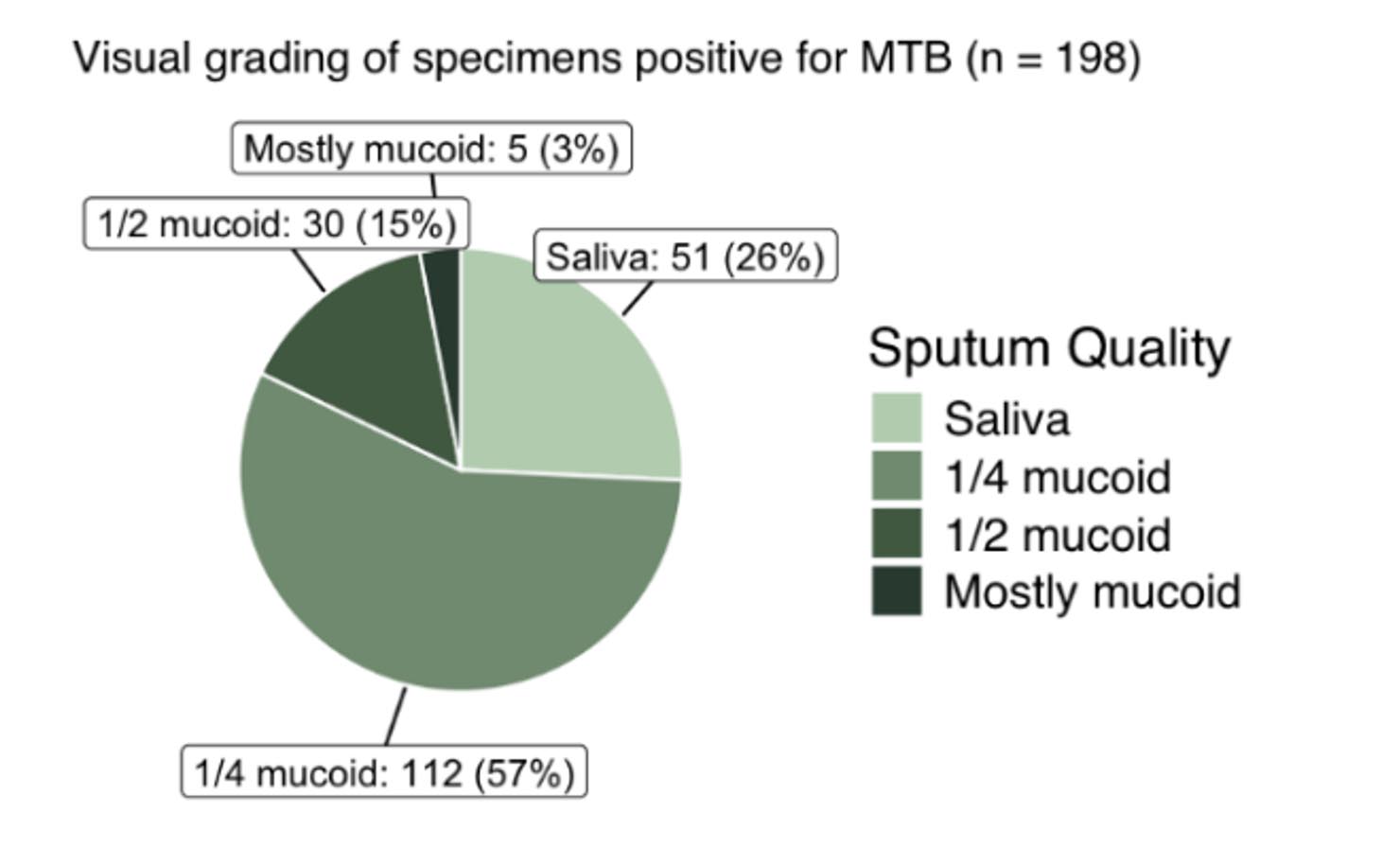
Figure 1, representing the visual grades of specimens that tested positive for TB, shows that one quarter (26%) of positive results came from specimens classified as saliva (26%, 51/200), and more than three quarters (82%, 163/198) came from specimens that were graded as saliva or only ¼ mucoid.